- Analyst Philip Cusick from Bloomberg gives Comcast an Overweight rating stating that “solid cable segment growth, combined with an improved NBCU, makes for a strong and well-diversified cash flow stream.” Higher revenues in broadband and business services should continue, which may be about 50% of cable revenues by 2020, he says.
- “To be clear, we don’t love the Sky deal!” he said.
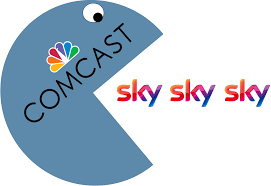
Comcast (NASDAQ: CMCSA) is playing with a burning building. Comcast announced that it won its bid for European pay-TV provider Sky (OTCMKTS: SKYAY). They won a dying business model and put them in more direct competition with Amazon and Netflix that have disrupted that business model. This strategy wasn’t working for AT&T, so what was Comcast thinking?
For CMCSA stock to gain investor confidence, the company had to find some way to improve their business. Although Comcast’s CEO Brian Roberts was pressured to be like Disney’s Bob Iger, they probably should focus more on what they do best and that is improving their internet cable business like Verizon has focused on investing in their wireless network instead of doing what AT&T is doing. Disney won the acquisition for Fox (NASDAQ: FOXA) and it seemed if Comcast didn’t step up, Disney may have owned Sky too.
Investors I believe will question why management handed over almost $39 billion for a business that was cash poor and saddled with a heavy debt burden. Comcast stock is extremely leveraged too and adding more risk to their balance sheet does not seem like the magic trick that will improve their financial situation. Therefore, buying CMCSA stock exposes investors to about $62 billion in debt while only having $5.7 billion in cash. Most of the Sky deal had to financed.
With a stronger dollar and interest rates at multi-year highs, the timing could be bad. So why did Comcast fight for Sky? They may have failed in doing their due diligence and applying some common sense.
To help answer the question, both Comcast and Disney were engaged in acquiring Sky due to its synergies with their existing businesses. Sky owns European TV, which would give their owner access to many wildly popular tv programs. With either Comcast or Disney, they could add their own content, which may be already paid for to maintain their presence in the U.S., which would easily increase the selection of available programs for new and existing subscribers.
One big benefit of Sky is that the British media giant owns the exclusive broadcasting rights to the English Premiere League (EPL). The EPL is like the NFL in the U.S., but in many ways more popular among the populous. Soccer, or football as they like to call it, is the most popular sport in the world and the EPL is its most popular league.
As I made a reference to the poor acquisitions made by AT&T and how Comcast should learn from their mistakes, Comcast should have learned a lesson from its rival Disney too. Disney’s weakness in its financial performance is ESPN. Sports viewership has declined over the years and it has impacted all professional sports organizations. While mainstays like the NFL and NBA are most likely here to stay for the foreseeable future, the financials don’t lie about it being a poor performer in the paid-TV space. Now Comcast has inherited possibly the same problem that Disney is facing with ESPN.
TV viewership has been declining for English soccer’s top-tier clubs, especially clubs like Manchester United have suffered viewership declines. Sky TV had recently reported a multi-year record decline in average viewership stats. So Comcast may have boarded a sinking ship.
5G technology represents the future and not just for downloading speeds. This next-generation of technology innovation that was previously the exclusive realm of science fiction is now a real possibility and a threat to Comcast’s core business, cable internet. In a way Comcast is trying diversify away from this threat, but I believe Comcast should re-focus their energies on being the best internet service provider (ISP). If investing in 5G is what they need to do, then acquiring T-mobile or Sprint would have been the more logical choice then Sky.
Just look at the trends and like some on Wall Street would say, don’t fight the trend. Regular sports watching over paid-TV is dying. Comcast should learn from Disney and AT&T that you should not acquire businesses that are being disrupted or lacking serious growth potential. Although I did not get a chance to say much about Verizon, but Comcast had an opportunity to compete against that giant in 5G and be not only in customer’s homes, but constantly in their hands through mobile devices. Maybe Comcast will change their strategy or acquiring T-mobile or Sprint is a possibility. However, the company has a lot to do to demonstrate to investors that they are on the right path.
As of this writing, Doug Taylor did not hold a position in any of the aforementioned securities.

Doug Taylor is a seasoned journalist with nearly 10 years experience. While studying journalism at the University of California, Doug found a passion for finding engaging stories. As a contributor to Oracle Savvy, Doug mostly covers state and national developments.